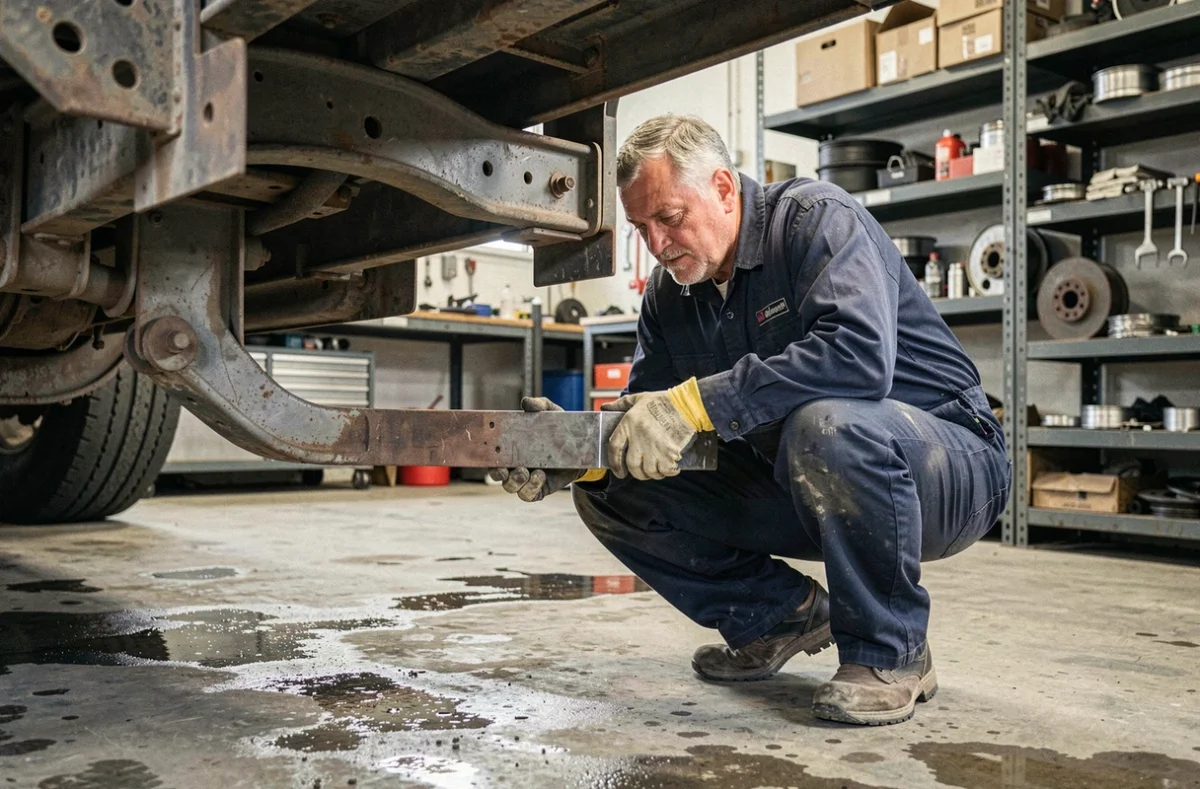
Anti-encroachment bars equip almost all heavy goods vehicles operating in Europe, but their regulatory framework remains poorly understood by operators and drivers alike. What texts govern their installation, what differences exist between a rear bar and a side protection, and what vehicle configurations pose compliance issues? This article reviews the applicable obligations and concrete points of vigilance.
UN/ECE Regulation R58-03 and Side Protection: Table of Obligations
Two distinct texts govern anti-encroachment devices on trucks. UN/ECE Regulation No. 58 (in its revision 03, known as R58-03) concerns rear bars. Side protection falls under UN/ECE Regulation No. 73. These two texts set different requirements regarding strength, positioning, and dimensions.
| Criterion | Rear Bar (R58-03) | Side Protection (R73) |
|---|---|---|
| Position on the Vehicle | Cross member fixed under the chassis, at the rear | Device covering the area between axles, on the sides |
| Main Function | Prevent a light vehicle from getting lodged under the rear of the truck | Prevent a pedestrian or cyclist from passing under the vehicle laterally |
| Concerned Vehicles | Heavy goods vehicles, trailers, semi-trailers (maximum weight over 3.5 t) | Trucks and trailers whose width exceeds a certain threshold |
| Mechanical Resistance | Point and distributed load test defined by the regulation (multiple application points) | Resistance to a horizontal force defined by the regulation |
| Maximum Height Above Ground | Lower edge at a limited distance from the ground, set by the text | Lower edge close to the ground, upper edge connected to the vehicle structure |
The distinction between these two devices is often overlooked. A truck may comply with R58-03 for its rear bar while having a defect in its side anti-encroachment regulation, which constitutes a separate non-compliance during technical inspection.
Exemption Cases and Problematic Configurations for Anti-Encroachment Bars
Not all heavy goods vehicles are subject to the same obligations. Certain categories of vehicles benefit from total or partial exemptions, depending on their use or design.
- Tipper trucks and lift gates pose a direct mechanical problem: the movement of the tipper or lift gate conflicts with the fixed position of a conventional rear bar. Technical solutions exist (retractable bars, automatic lifting bars), but their approval must correspond to the applicable regulation.
- Special use vehicles (equipment carriers, mobile cranes, certain off-road vehicles) may be exempt if their design makes the installation of a bar technically incompatible with their primary function.
- Semi-trailers equipped with a specific coupling device may have their rear area partially obstructed, which alters the installation conditions of the cross member.
The common point of these cases: the exemption does not exempt from a compliance review. The operator must be able to justify that the vehicle’s configuration falls within the scope of a derogation recognized by the regulatory text, under penalty of sanction during inspection.
Technical Inspection of Trucks: What is Checked on the Rear Bar
The technical inspection of heavy goods vehicles includes a visual and functional examination of the rear anti-encroachment bar. Inspectors check several concrete elements.
Common Inspection Points
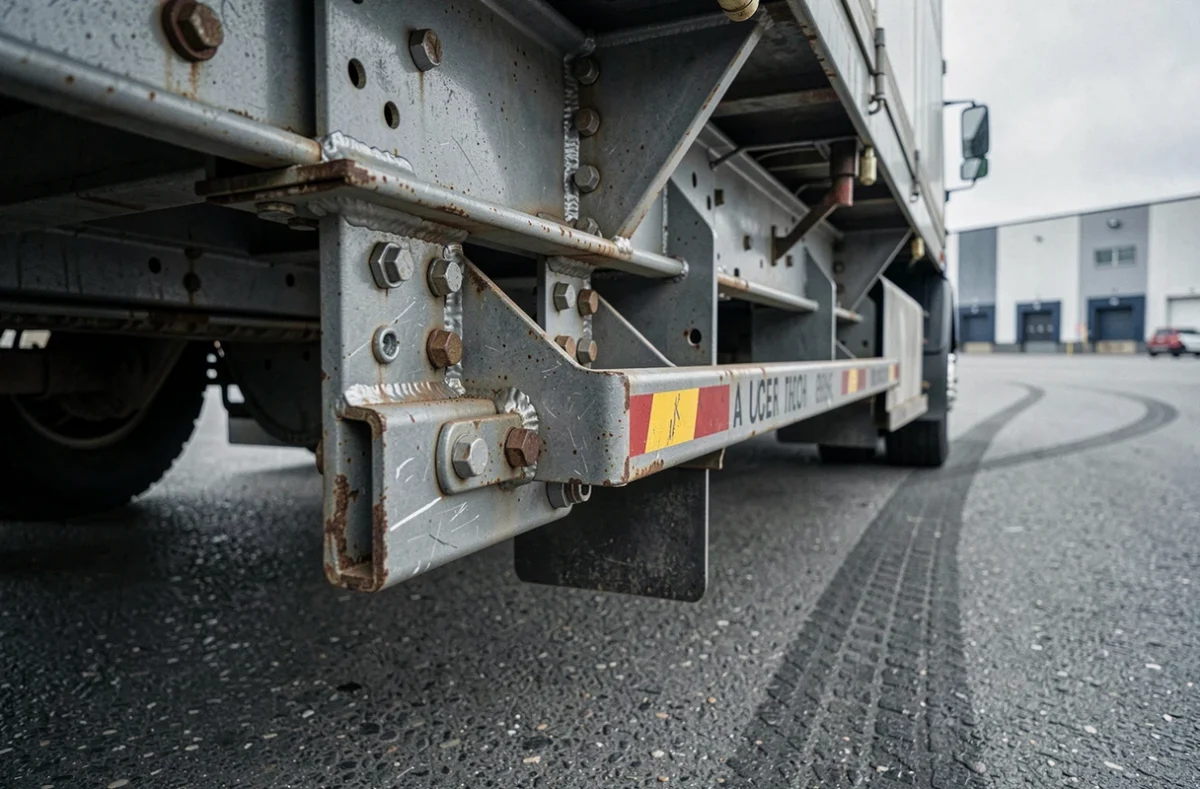
The general condition of the cross member is the first criterion. A bar showing advanced corrosion, visible deformation, or loose fixings will be flagged as a failure. The positioning relative to the ground is also checked: if the bar is too high or too far back from the rear bumper, it no longer fulfills its anti-encroachment function.
The presence of an approval marking (reference to regulation R58 or R58-03) is also verified. A homemade device, even if robust, does not meet the requirement if no approval marking is visible.
Consequences of Non-Compliance
A failure noted on the rear bar can lead to a re-inspection, or even immobilization of the vehicle if the defect is deemed critical for safety. In contrast, a simple aesthetic defect (chipped paint without structural corrosion) generally does not result in a prescription. The difference between a minor defect and a major defect depends on the impact on the mechanical resistance of the device.

Rear Anti-Encroachment Bar and Removable Equipment: Technical Compatibility
The addition of a lift gate, step, or coupling changes the rear area of the vehicle. The question of compatibility between the anti-encroachment bar and these devices arises with each modification.
A retractable or automatic lifting bar allows access to the lift gate while complying with the standard. This type of device must also be approved according to R58-03. A modified bar without new approval loses its compliance, even if it remains mechanically functional.
For vehicles equipped with a coupling, the rear cross member must take into account the presence of the fifth wheel or hook. Some manufacturers offer bars integrated into the chassis from the design stage, which simplifies compliance. Aftermarket installations, more common on older vehicles, require particular attention to technical documentation and marking.
The burden of proof lies with the operator: in the event of an inspection, it is the operator who must present the approval certificate for the installed device. A vehicle whose bar has been replaced or modified without documentary traceability is at risk of a validation refusal during technical inspection, regardless of the physical condition of the part.