
The market for thermal brush cutters remains broad, with varying engine sizes, cutting systems, and comfort levels from one model to another. In the face of this offering, traditional buying guides pile up criteria without always prioritizing what matters according to the actual terrain and frequency of use. Choosing a thermal brush cutter for your garden requires balancing technical, regulatory, and ergonomic constraints that a mere reading of a product sheet cannot adequately resolve.
Noise disturbances and local regulations: the overlooked filter before purchase
Before comparing engine sizes, one parameter conditions the very possibility of using a thermal brush cutter: noise. The hours of use for motorized gardening tools depend on municipal or prefectural decrees. There is no universal time slot applicable everywhere in France.
In densely populated residential areas, noise can still be considered bothersome even during permitted hours, depending on its duration, repetition, or intensity. A powerful thermal brush cutter used regularly in a housing estate can generate neighborhood conflicts, even when the user adheres to the time slots displayed at the town hall.
Comparisons on top-debroussailleuse-thermique.com allow you to cross-reference power and noise level to identify the least noisy thermal models in each engine size range.
Consulting your municipality’s decree before purchase prevents you from ending up with a device that is too noisy for the intended use. Some municipalities restrict use to a few hours on weekends, making a thermal model impractical if you can only maintain your garden on weekends.
Engine size and thermal engine: what power changes concretely
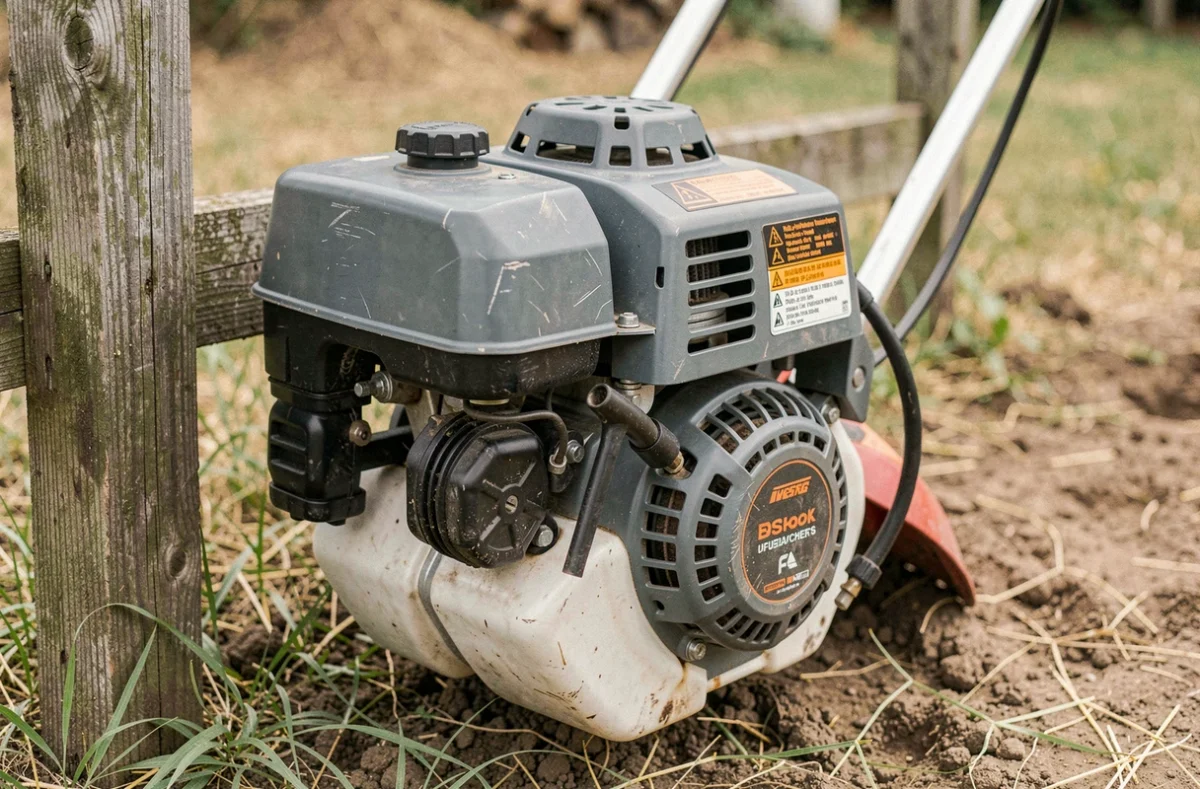
The engine size of a thermal brush cutter determines its ability to cut through more or less dense vegetation. Smaller engine sizes are suitable for the regular maintenance of an already mowed garden, while larger sizes tackle brambles, woody undergrowth, and neglected land.
Two-stroke or four-stroke engine
The majority of thermal brush cutters on the market are equipped with a two-stroke engine, powered by a gasoline-oil mixture. This type of engine offers a good power-to-weight ratio, which is important for a tool held at arm’s length for extended periods.
Four-stroke engines, less common in this segment, consume less and produce fewer exhaust gases. They are also heavier. The choice between two-stroke and four-stroke mainly depends on the duration of use: for prolonged and frequent use, respiratory comfort and fuel consumption favor the four-stroke. For short and occasional interventions, the two-stroke remains more manageable.
The issue of mixing and engine maintenance
A two-stroke engine requires a gasoline-oil mixture prepared in the proportions indicated by the manufacturer. An approximate dosage degrades performance and shortens the engine’s lifespan. Using ready-to-use alkylate fuel simplifies preparation but costs significantly more than homemade mixtures.
Routine maintenance (air filter, spark plug, carburetor) remains accessible to an individual equipped with basic tools. Neglecting to clean the air filter reduces engine power and increases fuel consumption.
Cutting system: line, blade, or disc according to garden vegetation
The cutting system is the second structuring criterion after the motorization. Three main families coexist, and none is universal.
- Nylon line (round, square, or serrated) is suitable for tall grass, grasses, and edge finishing. It wears out quickly on thick vegetation and projects few dangerous debris, making it suitable for gardens with paths or nearby furniture.
- The two or three-tooth blade cuts through brambles, thick nettles, and young woody shoots. It requires a clear terrain free of stones to avoid projections and damage to the blade.
- The brush disc, often made of steel, tackles dense undergrowth and small shrubs. Its weight and inertia make the machine more tiring to handle, and it should only be used with a quality harness.
On rocky terrain, the protective cover and type of cutting tool matter as much as power. Some professional notices recommend a free perimeter of fifteen meters around the operator to limit the risk of projection. The manual for the model in question takes precedence in all cases.
Vibrations and ergonomics: the criteria that separate occasional use from regular use
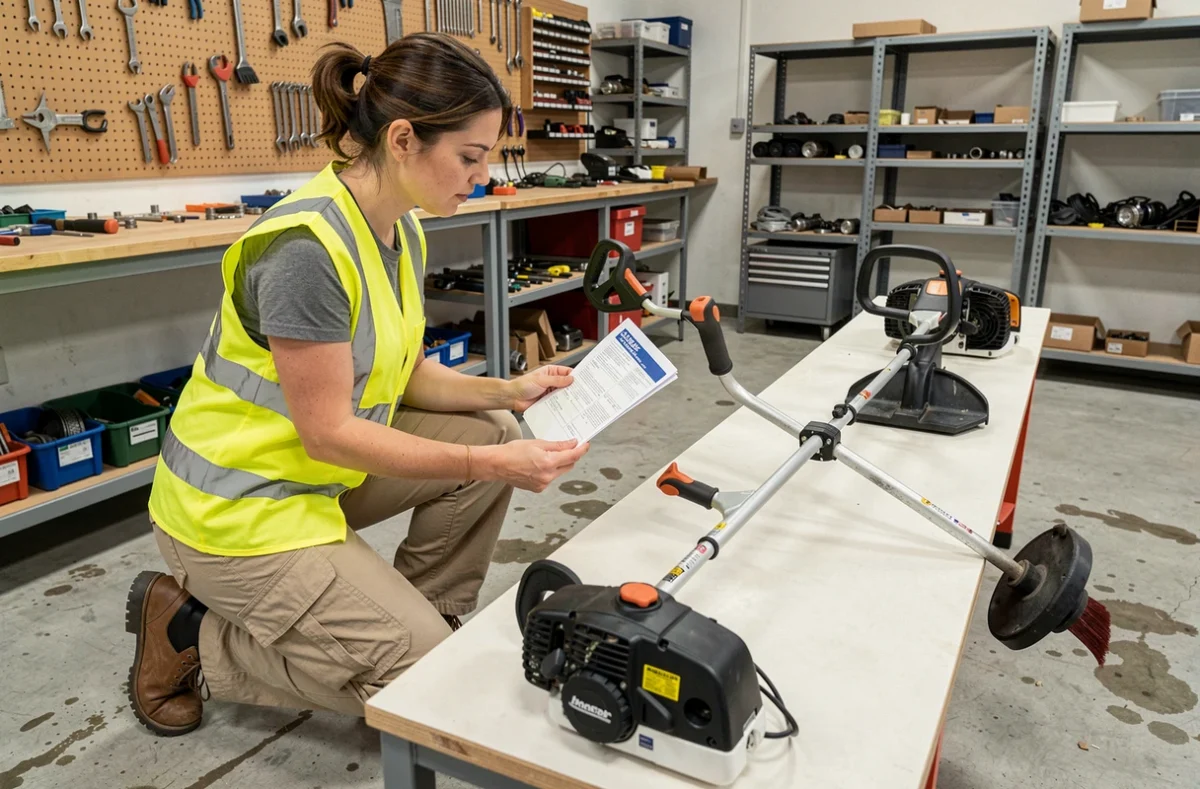
Buying guides often mention the weight of the machine but rarely the level of vibration transmitted to the hands and arms. For occasional use, a few dozen minutes per month, this issue remains secondary. It becomes central as garden maintenance involves sessions of over an hour, several times a season.
The vibration level is listed in the manufacturer’s technical sheet, expressed in meters per second squared. An effective anti-vibration system reduces muscle fatigue and long-term risks. Not all models are equal in this regard, even with equivalent engine sizes.
The harness, often underestimated
A simple strap harness shifts the weight onto one shoulder. Sufficient for a lightweight trimmer, it becomes uncomfortable with a medium or larger thermal brush cutter. Double strap harnesses distribute the load across the torso and hips. Professional forestry-type harnesses include lumbar support and a low attachment point that stabilizes the machine at hip height.
The type of handle also influences working posture. The bicycle-type handlebar promotes wide sweeping movements on flat terrain. The loop handle offers more maneuverability on sloped or uneven terrain.
Thermal brush cutter and legal obligations for clearing
In municipalities classified as at risk of forest fires, clearing is a legal obligation for property owners. European regulations also govern emissions from small power engines used in non-road equipment, which includes thermal brush cutters.
These standards are gradually influencing the available offerings: older models or those with poorer catalysts are disappearing from catalogs. When purchasing, checking the engine’s compliance with current standards ensures both the legality of the device and its availability of spare parts in the medium term.
Choosing a thermal brush cutter is not just about comparing power. The local regulatory framework, type of vegetation, frequency of use, and operator comfort form a set of constraints that it’s better to cross-reference before placing an order, rather than discovering them through use.