
In September 2026, Kim Kardashian liked a post by Macklemore calling for the liberation of Palestine and promising donations to humanitarian organizations. No public statement followed this gesture, but the controversy erupted instantly. We are faced with a concrete case of crisis communication: a celebrity whose every interaction on social media is scrutinized by millions of followers, and whose slightest like becomes a political act.
A like on social media and its commercial consequences for Kim Kardashian
The underlying issue is not the like itself. It lies in what surrounds Kim Kardashian on a commercial level. Her brand Skims is developing activities in Israel, creating a direct tension between a pro-Palestinian sympathy signal and economic interests.
In practice, her business partners monitor the consistency between her public statements and her market choices. A pro-Palestinian like followed by no explanation, while the brand remains present in Israel, generates exactly the type of ambiguity that communication teams fear.
One can analyze Kim Kardashian’s support for Palestine as a sincere gesture or as a digital navigation accident. In both cases, the effect on her image is the same: a question that does not dissipate until there is a structured statement.
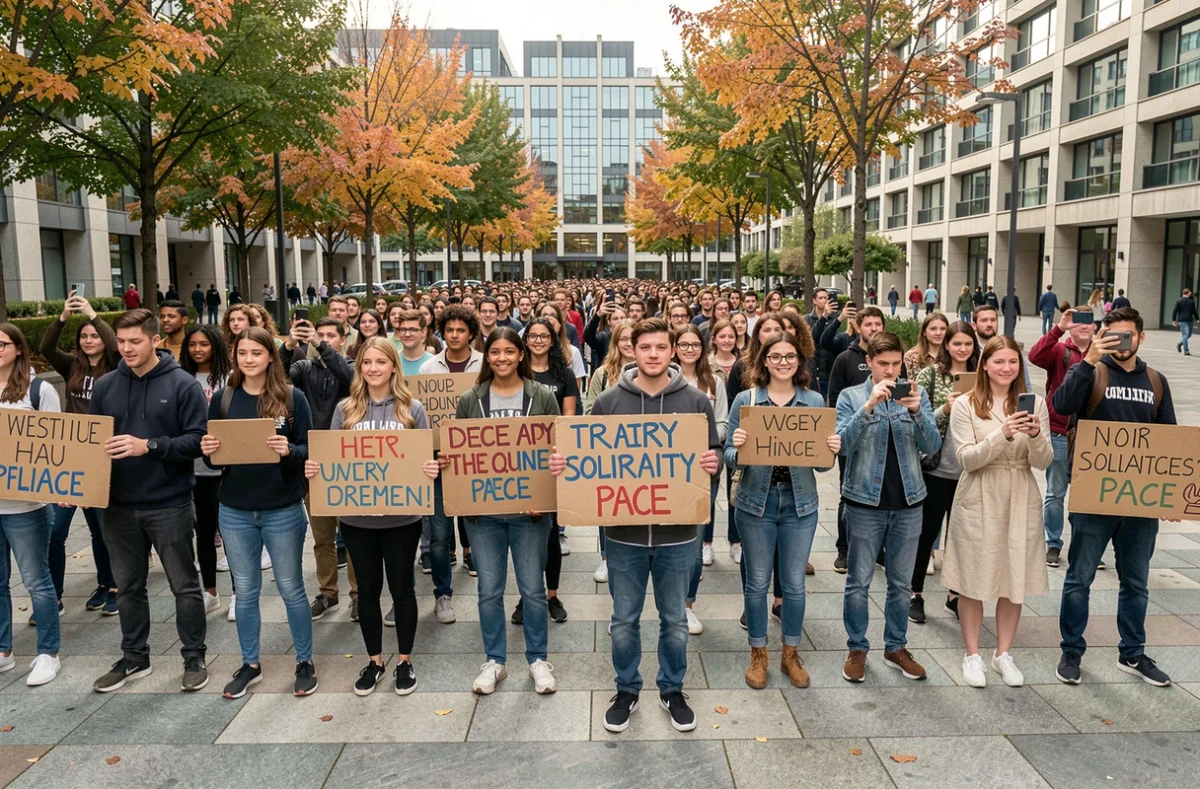
The Israeli-Palestinian conflict and celebrities: the trap of calculated silence
The precedent of 2023 sheds light on the current situation. Kim Kardashian had then posted a tweet supporting Israel before broadening her message to Palestinians, only to delete everything. She later apologized, explaining that some people were hurt by her words.
This pattern – posting, rectifying, deleting, apologizing – has become a textbook case of what not to do when venturing into a sensitive geopolitical topic. Internet users archive everything. Deleting a message does not erase the controversy; it amplifies it.
The digital boycott movement targeting silent celebrities on Gaza
Since the resumption of hostilities, a digital boycott movement has targeted personalities perceived as silent on the situation in Gaza. Kim Kardashian is among the celebrities regularly called out. The criticism is twofold: not taking a clear stance and continuing to post promotional content as if nothing were happening.
This boycott has translated into unsubscribe campaigns and massive comments under her posts. The concrete impact on her followers remains difficult to measure precisely, but the visibility of the dissent is real.
Kardashian political opinions: a history of cautious positioning
Kim Kardashian is not the only one in her family to navigate cautiously on political issues. A recurring strategy can be observed among the Kardashians:
- Late positions, formulated after gauging public and media reaction
- Deliberately vague messages, focused on general compassion rather than a specific camp
- A quick withdrawal as soon as the controversy escalates, followed by prolonged silence
This approach protects in the short term, but it erodes credibility in the long term. Audiences now expect celebrities to own their positions, especially when they have a media reach comparable to that of Kim Kardashian.
The specific case of the Armenian genocide
Her detractors have drawn a comparison between the current situation and the Armenian genocide, for which Kim Kardashian had actively lobbied Washington for official recognition. This comparison, although historically debatable, highlights a perceived contradiction: why engage for one cause and remain vague on another when both touch on civilian suffering.

Kim Kardashian’s public image in France and worldwide: what has changed
In France, the media coverage of this affair followed a predictable pattern. Celebrity media relayed the controversy, and reactions on Francophone social media were virulent. The Israeli-Palestinian conflict strongly mobilizes French public opinion, amplifying the echo of every misstep.
Specifically, Kim Kardashian’s positioning on Palestine affects her image through three mechanisms:
- The loss of trust from some of her followers who expected a clear and committed stance
- The perceived incompatibility between her business activities in Israel and any potential support for the Palestinian cause
- The effect of digital memory: each new controversy reactivates previous ones, creating a cumulative effect of controversies
Feedback varies on this point, but it is noted that ambiguity is more damaging than the stance itself. Personalities who have taken a side, whatever it may be, have generally weathered the media storm better than those who tried to please everyone.
Advertising and partnerships: the economic variable
For brands collaborating with Kim Kardashian, the question is pragmatic. A partnership with a controversial figure on a geopolitical issue represents a communication risk. Advertisers now assess what is called “reputational risk” before signing a contract with a public figure exposed to this type of controversy.
Kim Kardashian has not publicly documented the loss of major contracts due to this controversy. However, the accumulation of controversies since 2023 weighs in negotiations, according to the simple logic of the benefit-risk ratio that every advertiser applies.
The case of Kim Kardashian illustrates a reality that far exceeds the world of celebrities: in a context where every digital gesture is archived and interpreted, the absence of a clear position becomes a position in itself. And it is often the most costly.