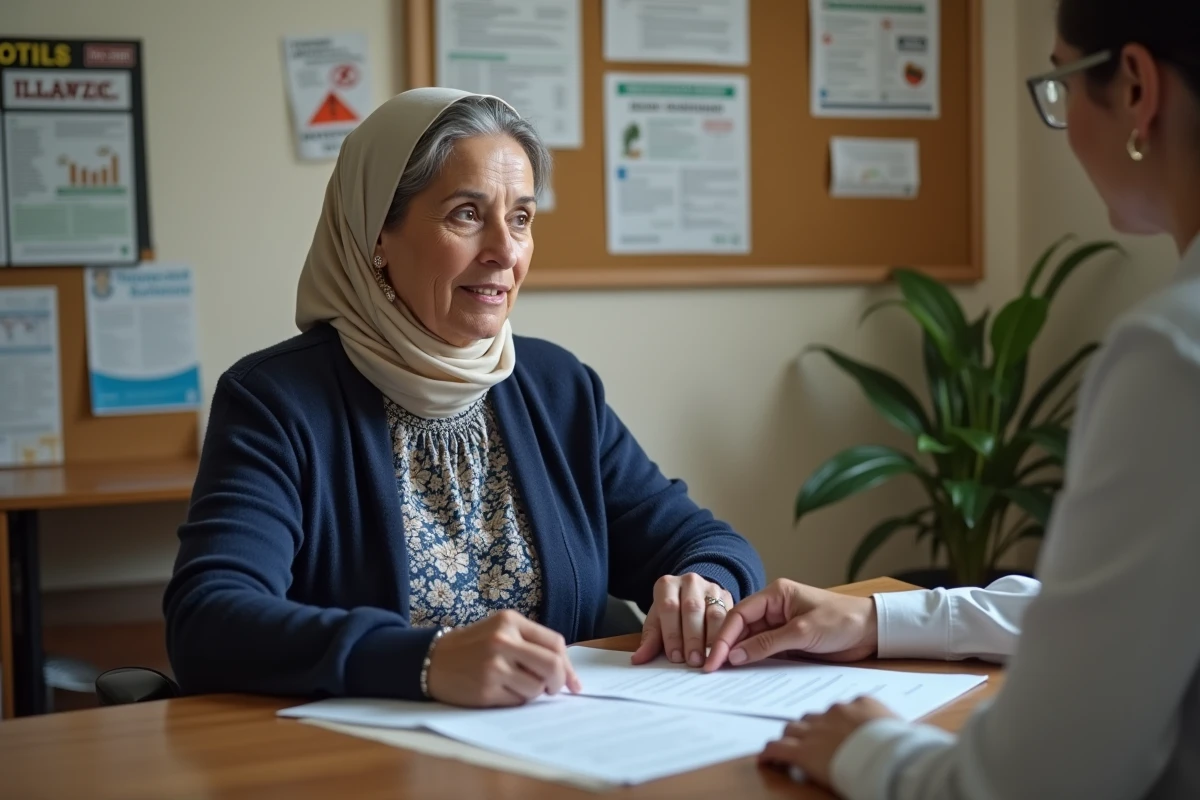
A person in an irregular situation presents themselves at an associative reception center, exhausted, with no solution for the night. The volunteer hesitates: does he have the right to host them? What assistance is concretely available when one does not have a residence permit? The French legal framework clearly distinguishes between emergency accommodation, accessible to all, and traditional housing assistance, reserved for residents in a regular situation. Understanding this distinction changes everything in daily support.
Emergency accommodation without a residence permit: an unconditional right
In France, the principle of unconditional reception applies to emergency accommodation. Any person in distress, regardless of their administrative situation, can be welcomed into the generalist system Accueil Hébergement Insertion (AHI).
The administrative judge has repeatedly reminded that the administration cannot refuse reception solely on the grounds of the absence of a residence permit. This case law, reinforced in recent years by the Council of State, constitutes a real legal protection for undocumented individuals.
In practice, individuals are directed to 115 (social emergency number) or to accommodation centers managed by associations. The administrative regularity status is not a condition for admission to these structures. Returns on this point vary by region, as the saturation of places makes access difficult in large urban areas, but the legal principle remains firm.
To better understand the legal framework applicable when deciding to offer housing assistance for undocumented individuals, it is also necessary to distinguish between citizen hosting and organized assistance for residence, as the legal consequences differ.
Hosting an undocumented person at home: what French law says

An individual who welcomes a person in an irregular situation into their home does not automatically commit an offense. French law distinguishes disinterested humanitarian aid from assistance for irregular residence.
Providing shelter, a meal, or social support to an undocumented person is generally considered assistance. However, the law penalizes organized aid that facilitates entry or prolonged stay in the territory for profit or systematically.
This boundary remains a sensitive point in practice. Three guidelines can be retained to navigate this:
- The occasional and free hosting of a person in distress is protected by the humanitarian exemption provided by the code of entry and residence of foreigners
- Material aid (food, clothing, referral to social services) does not constitute an offense when it is disinterested
- The repeated organization of transport, accommodation, or employment for a person without a title, in a structured and paid framework, may expose one to prosecution for assistance with irregular residence
Welcoming associations and legal clinics are not required to verify the administrative status of the individuals they receive. They can therefore welcome whomever they wish in their premises.
Social assistance and housing for undocumented individuals: what is accessible and what is not
Housing allowances paid by the CAF (APL, ALF, ALS) are reserved for individuals with a valid residence permit. An undocumented person cannot receive traditional housing assistance.
However, other systems remain open. The right to administrative domiciliation allows homeless individuals, including those in irregular situations, to obtain an address through a municipal social action center or an approved association. This address is essential to initiate any process: access to healthcare via state medical assistance, opening a bank account (right to a bank account), or preparing a regularization application.

In terms of concrete housing, the most realistic solutions for individuals without a residence permit go through associative systems:
- Rental intermediation, where an association rents a property and then sublets it to the accompanied person, without requiring a residence permit
- The sliding lease, which ultimately allows the lease to be transferred to the occupant’s name once their situation is regularized
- Associative subletting, used by some structures to temporarily house families awaiting regularization
These systems are more accessible than direct rental, which requires providing proof of residence and income. However, they remain limited in volume and heavily depend on the local associative fabric.
Asylum seekers and the national reception system: a distinct circuit
Asylum seekers undergoing the procedure benefit from a specific accommodation circuit, the National Reception System (DNA). This network includes reception centers for asylum seekers (CADA) and dedicated emergency accommodations.
The DNA is reserved for individuals whose asylum application is under review. Once the application is rejected, the individual loses access to this system and shifts to general accommodation, with the difficulties that entails.
The distinction between asylum seeker and rejected individual is therefore crucial. In the first case, structured social support exists, with referral to accommodation and payment of the asylum seeker allowance. In the second, one returns to the principle of unconditional reception of the AHI system, without specific allowance.
Legal support plays a central role at this stage. Associations specializing in immigration law can help identify still-open regularization pathways (through work, family ties in France, or humanitarian reasons) and prepare a solid file before any appointment at the prefecture.
The housing of undocumented individuals in France relies on a balance between the right to emergency accommodation protected by case law and the exclusion from traditional housing assistance. Concrete solutions go through the associative network, administrative domiciliation, and rental intermediation systems. Knowing these mechanisms allows for effective guidance of the individuals concerned towards the structures suited to their situation.