
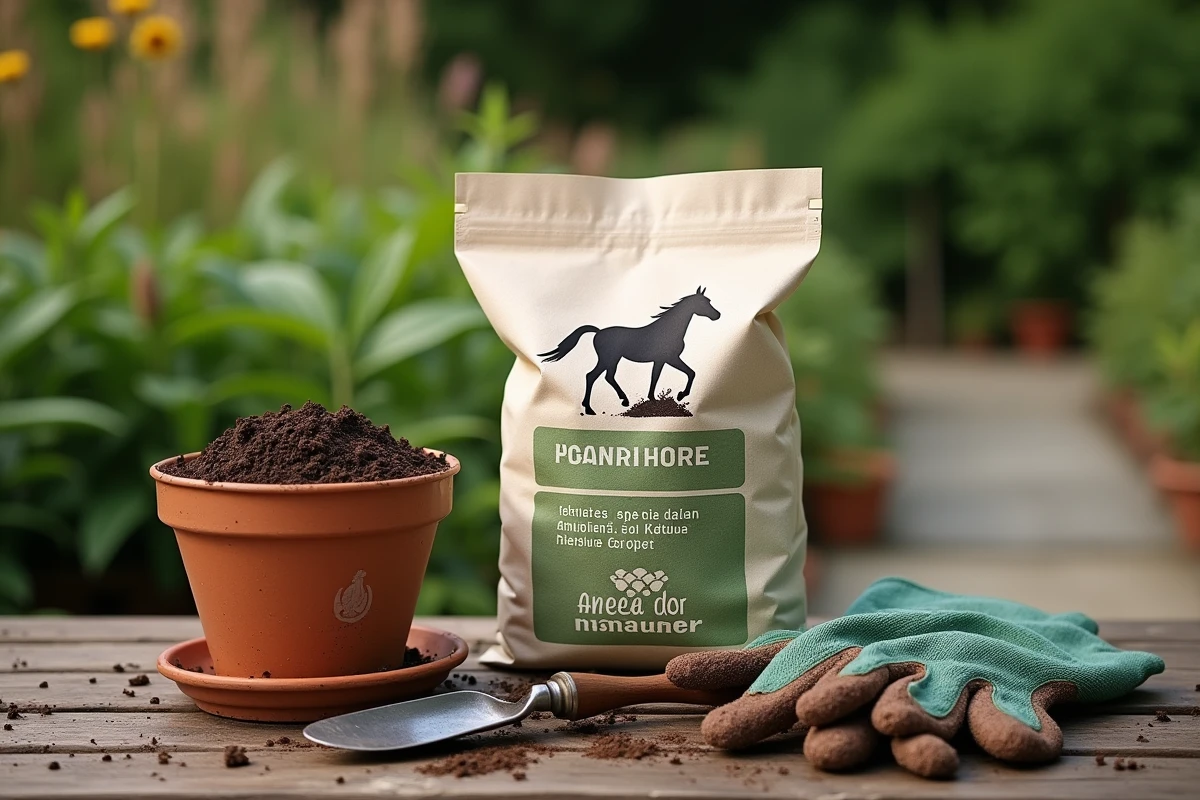
The horse manure sold in supermarkets, particularly at Lidl during its seasonal promotions, has little in common with the pile of droppings collected from an equestrian center. The packaged product has undergone an industrial composting process and often includes complementary plant materials. Understanding this difference changes how to apply it in the garden, the dosage, and the expected results.
Lidl Horse Manure: What the Bag Really Contains
The manures packaged for retail combine equine manure with an increasing proportion of composted plant materials (bark, coconut fibers, green compost). This trend aims to standardize the product, reduce odors, and limit the risk of burning young plants.
The result is a more consistent amendment than raw manure, but also less concentrated in immediately available nitrogen. For a gardener who finds tips on Lidl horse manure in online guides each year, this nuance is rarely explained: the product acts more as a soil amendment than as a quick-acting fertilizer.
Fresh manure collected in bulk from a stud farm heats up during decomposition and quickly releases nitrogen. The Lidl bag, on the other hand, has already gone through this thermal phase. Its effect on soil structure is gradual, making it more forgiving of dosage errors, but less spectacular on a nutrient-hungry crop with a short cycle.
European Regulation on Fertilizers: What the Label Guarantees
Since July 2022, the Regulation (EU) 2019/1009 on fertilizing products has been fully applicable. Packaged manures labeled as organic amendments must meet harmonized thresholds for contaminants (heavy metals, plastic impurities) and display nutrient content on the packaging.
This regulatory framework clearly distinguishes a packaged product from bulk manure. A bag bearing the CE marking for fertilizers offers minimum guarantees of traceability and health safety that a pile of fresh manure, however generous, cannot provide.
The label deserves careful reading before purchase. Three pieces of information are mandatory:
- The functional category of the product (organic soil amendment, not fertilizer in the strict sense), indicating that the primary goal is to improve soil structure rather than directly nourish plants
- The declared contents of nitrogen, phosphorus, and potassium, even if they remain modest compared to mineral fertilizers
- The maximum thresholds of contaminants respected, in accordance with the annexes of the European regulation
This transparency allows for an objective comparison of Lidl manure with other organic amendments sold in garden centers. Field feedback varies on this point, with some gardeners finding the product too light compared to farm manure, while others appreciate its ease of use.
Spreading Packaged Horse Manure: Suitable Periods and Soils
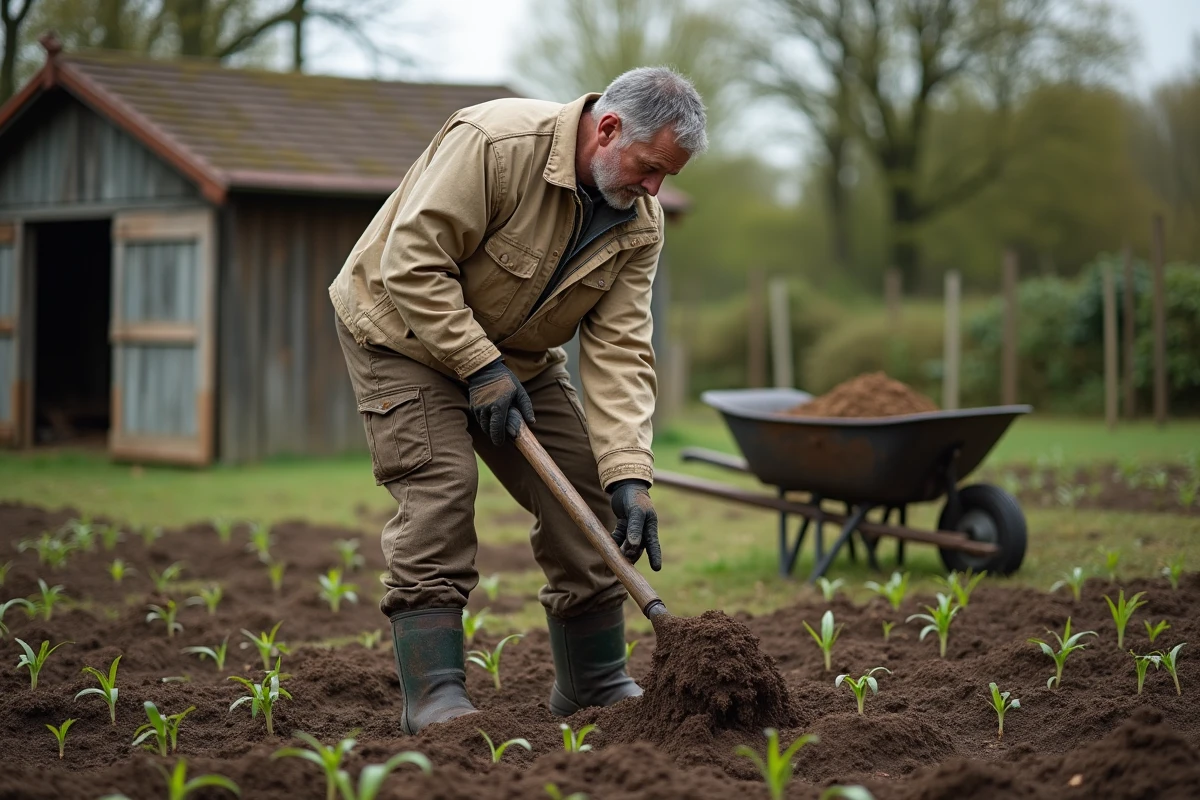
Autumn remains the most relevant time to incorporate this type of amendment. Spread in a layer over the plots after the last harvests, composted manure works the soil during winter under the combined action of frost, rain, and microbial life.
On clay soil, the addition improves drainage and aeration capacity. On sandy soil, it increases water retention and particle cohesion. In both cases, the benefit is more about the physical structure of the soil than about immediate nutritional input.
A spring application is possible, but with a precaution: since the product is already composted, it does not heat up like fresh manure. Therefore, it will not warm the growing beds. For early sowing of nutrient-hungry vegetables (tomatoes, squash, zucchini), it is better to have amended in the previous autumn.
Dosage and Layer Thickness
The packaging usually indicates a surface area covered per bag. In practice, a regular layer of a few centimeters is sufficient for annual maintenance. Doubling the dose does not accelerate results and may create an excess of undecomposed organic matter on the surface.
A light raking to incorporate the amendment into the top few centimeters promotes contact with soil fauna. Deeply burying it with a spade does not provide any additional benefits and disrupts the biological horizons that one seeks to nourish.
Limitations of Packaged Manure Compared to Farm Manure
The main criticism directed at supermarket manures concerns their lower content of active organic matter compared to well-managed farm manure. The dilution with composted plant materials stabilizes the product but also reduces its ability to quickly stimulate soil biological activity.
For an intensive vegetable garden with tight rotations and demanding crops, bagged manure may prove insufficient as the sole source of amendment. Combining it with organic mulching (hay, wood chips, dried grass clippings) partially compensates for this limitation by providing fresh carbon that the microfauna will transform over the months.
The available data does not allow for a definitive conclusion on the systematic superiority of one over the other. Fresh farm manure potentially contains weed seeds and medicinal residues (equine dewormers), two issues that industrial composting largely eliminates. The choice depends as much on the proximity of an equestrian center as on the desired level of control over garden inputs.
- Bagged manure is suitable for ornamental gardens, moderately cultivated vegetable gardens, and gardeners looking for the simplicity of a ready-to-use product
- Fresh farm manure, composted on-site for several months, remains preferable for highly degraded soils requiring a massive input of organic matter
- The combination of both (annual maintenance with bags, fresh manure as a foundational amendment every three to four years) constitutes a reasonable compromise
Lidl horse manure serves a specific role: maintaining the fertility of an already decent soil without the risk of overdosing. Expecting it to transform compacted or exhausted land would be asking more than it was formulated to do. Reading the label, adhering to the spreading schedule, and combining it with other sources of organic matter remain the three concrete levers to derive measurable benefits.